TP Service
 About
About
Principal in Strategic Design & Abstraction
 Consulting Service
Navigating the Leap in Product Management
 AI-Era Value:
Unrivaled Expertise
Business / UIUX
 Dieter Rams
10(→3+2) Principles for Good Design
 Theory
A Professional Perspective: the Golden Ratio
 UI Design
Four essntial steps of Micro Interactions
 Behavioral Economics
Utility:The Psychological Wallet and the Complexity of Product Growth
 PdM / CPO
Navigating the Core: The Evolution of a Product Designer
 UX Framework
The Pros and Cons of User Interviews
Art
 Marcel Duchamp
Marcel Duchamp And Modern Art
 Donald Judd
Minimalism and Abstraction
 Storm Thorgerson
Intentional Ambiguity
 Color Theory
The Boundless Potential of Color's Influence
Product
 King Sun & Pipistrello
An Elegant Table Lamp
 Danish Minimalism
Futuristic design that remains timeless.
 PH 4/3 lamp
Object's presence and its harmony with the space.
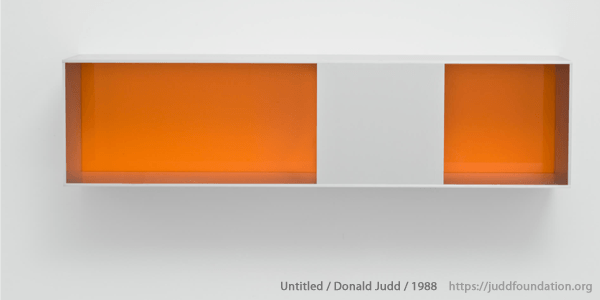
Art & ExpressionModern ArtDonald Judd and Minimalism
Critique - 2020 -
Our surroundings are filled with objects that enrich our daily lives. Take, for instance, a plastic storage case or a bookshelf. They are functional, working unobtrusively as they fit perfectly into the 'specific voids' of a cramped room. Rectangular and modest, they are sometimes tucked away beneath a bed, fading into near-invisibility.
Yet, humans yearn for a 'profound emotion' that exists apart from this inorganic existence. Whenever Van Gogh’s masterpieces arrive in Japan, they draw immense crowds; even a small concert hall in Ueno is enveloped in fervor day after day. This is because there lies something within them that stirs the very core of our being.
Donald Judd and Minimal Art
| Dates | 1928/6/3 - 1994/2/12 |
| Notable Works | Untitled series |
| Keywords | Three-dimensional works, Conceptual, Boxes, Furniture, Repetition, Minimal Art |
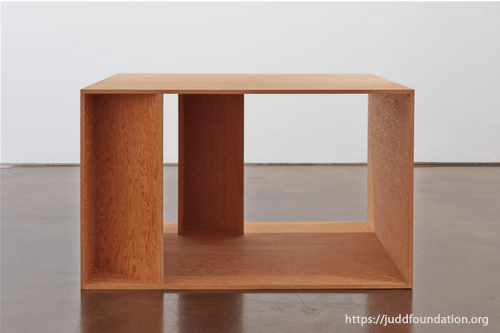
Untitled - 1989 -
Donald Judd, a native of Missouri, created works characterized by an inorganic nature—shapes (objects) so mundane they are scarcely recognized as art.
His oeuvre is frequently categorized as Minimal Art. Some define it as 'an artistic movement that attempts to strip away every superfluous element, presenting the absolute minimum unit that can still be debated as art.' Others position it as the antithesis of Abstract Expressionism—the movement that dominated post-war New York—or seek to find abstraction within the literal objects themselves.
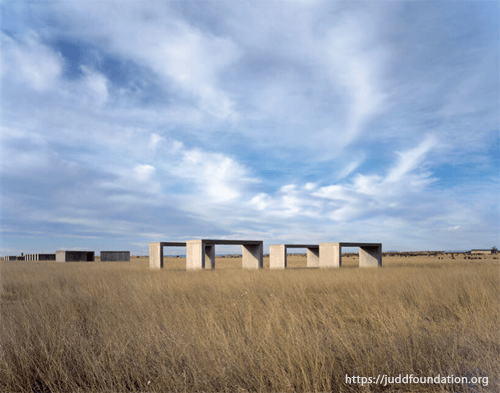
15 untitled works in concrete - 1980-1984 -
Since when did people begin to cast such solemn, artistic judgments upon a bookshelf in a corner or a closet in a bedroom? One feels tempted to simply say, 'There is nothing there.' Yet, the words and concepts woven by those who have strayed from the mainstream—proponents of Conceptualism and Minimalism alike—remain ever-ludicrous, ever-fragile.
MoMA and Donald Judd (Exhibition Retrospective)
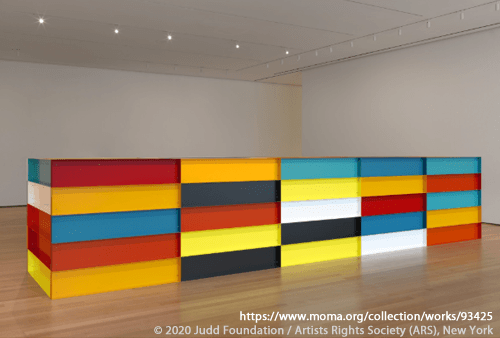
Untitled - 1991 -
In 2020, MoMA launched the first major retrospective of Donald Judd’s work in nearly thirty years. However, New York has since become one of the cities hardest hit by the global pandemic, a crisis that has shaken the world. The city has effectively lost its functional capacity. The exhibition, originally scheduled to run through July, now faces an uncertain future.
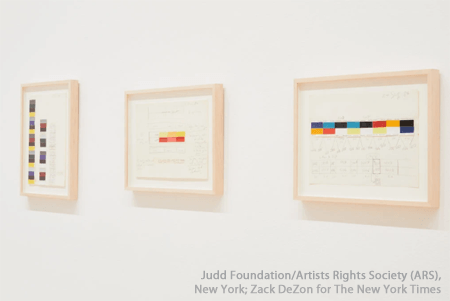
Detailed drawings
- 1984 (the first two, from left) and 1986 -
This exhibition even featured his blueprint-like sketches. They are undeniably beautiful; the somewhat tricky color arrangements are captivating, enough to make one stand still in contemplation for a long while.
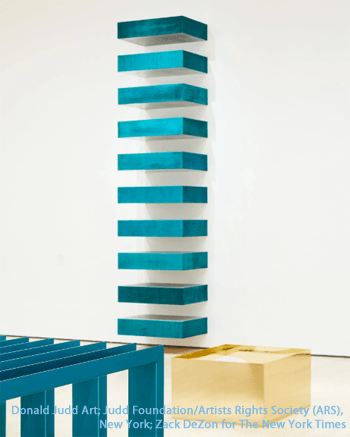
Untitled
- 1967 -
The New York Times reported on Judd’s work with pop-infused photography and a touch of witty prose. While praying for the day when people can once again reclaim their ordinary lives, encounter the art they love, and spend moments of peace, let us return to the critique.
Evaluation of Judd’s Work
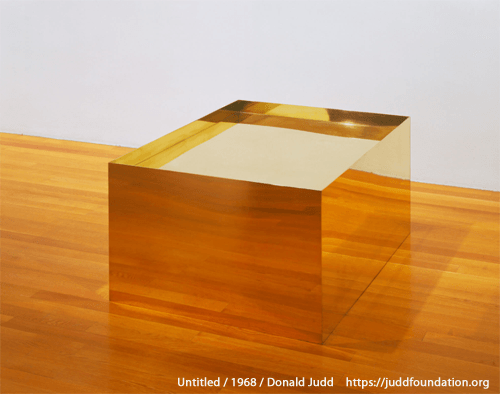
Untitled - 1968 -
It is a widely acknowledged fact that Judd’s work achieves a sense of 'minimization' within the realm of Minimal Art. However, if we scrutinize its essence, we fail to find the accumulation of energy that any exceptional work of art must possess. This stems from the fact that his minimalism is not the 'result of abstraction.' This is my artistic evaluation of Judd’s work, and it remains unshakeable.
Humanity is inherently vulnerable to 'definitions' placed before its eyes. As explained by the concept of 'hindsight bias' in behavioral economics, when presented with a commonplace small box or a mass of concrete, people tend to accept it as 'Minimal' or 'Art' simply because they are told it is so. We are fragile beings, prone to believing that 'it must be so' the moment a label is applied.
Roots and the Individual Core
In truth, Judd himself reportedly harbored a distaste for the term 'Minimal Art'; his intentions were directed elsewhere. While focusing solely on the 'essence' of a work is valid, doing so inevitably blinds us to the roots of what was filtered out. If we judge art only through the lens of personal likes, dislikes, or perceived quality, the faces and landscapes surrounding us will remain forever static.
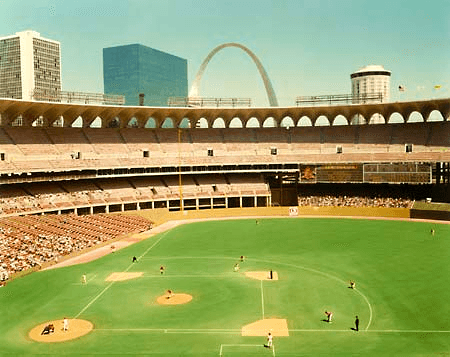
Busch Memorial Stadium - 1977 -
One could fill their room with copies of Cézanne and spend their days listening to nothing but Mozart. It sounds lovely, in a way, yet it is often these 'perfect' individuals who harbor the deepest stresses. In the various works you will encounter, you will find something beyond the mere 'essence of art'—something deeply precious to the individual creator. For example, New York photographer Joel Meyerowitz captured the famous arch of St. Louis, Missouri—the very state where Judd was born. His work 'Busch Memorial Stadium' is a personal favorite of mine; there must have been something in the landscape of St. Louis that stirred Meyerowitz’s soul. The same applies to Judd. The childhood experiences he had in Missouri likely became his 'original landscape' (Genfukei)—a fundamental element that shaped his identity and defined the architecture of his later works.
Judd and Us
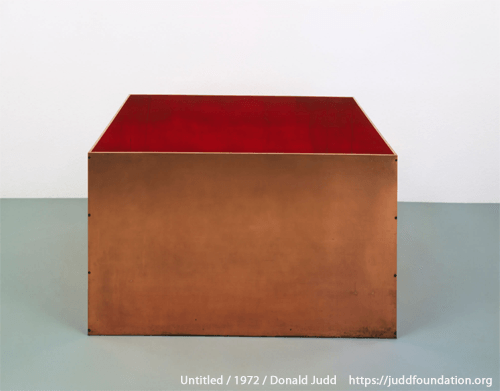
Untitled - 1972 -
Let us face this small box once more. Perhaps it is a work as profoundly conceptual as Christo’s wrapping paper. It certainly begins to appear so. No—there is no doubt about it. I have always found these counter-arguments—those that run contrary to the very essence of things—to be deeply unpleasant when imposed by others. Yet now, these questions arise from within myself. This is not 'uncertainty'; rather, it is a testament to growth, a mark of maturity. Through meeting remarkable people and being moved by their earnest devotion to others and to their craft, I, too, have learned various ways to engage with a work. One need not question the 'artistic essence' of the pure spirit within Judd’s work—a spirit that found solace and comfort in repeating objects and containers. .
For those of you who do not engage with design or art as a profession, there is no requirement to evaluate an object 'essentially or correctly.' I believe the most important thing is to fully and freely enjoy 'Art' as you personally define it. The simpler a work is, the more it may serve as a catalyst to reclaim the purity of childhood. And when your heart becomes as empty as one of Judd’s boxes, try speaking to a loved one with a smile. They will likely call you 'creepy.' But in that very moment, you are beginning to move forward once again. That, indeed, is the power of art.


TP Service
About
Principal in Strategic Design & Abstraction
Consulting Service
Navigating the Leap in Product Management
AI-Era Value:
Unrivaled Expertise
Business / UIUX
Dieter Rams
10(→3+2) Principles for Good Design
Theory
A Professional Perspective: the Golden Ratio
UI Design
Four essntial steps of Micro Interactions
Behavioral Economics
Utility:The Psychological Wallet and the Complexity of Product Growth
PdM / CPO
Navigating the Core: The Evolution of a Product Designer
UX Framework
The Pros and Cons of User Interviews
Art
Marcel Duchamp
Marcel Duchamp And Modern Art
Donald Judd
Minimalism and Abstraction
Storm Thorgerson
Intentional Ambiguity
Color Theory
The Boundless Potential of Color's Influence
Product
King Sun & Pipistrello
An Elegant Table Lamp
Danish Minimalism
Futuristic design that remains timeless.
PH 4/3 lamp
Object's presence and its harmony with the space.