TP
 About
About
AI-Era Value:Unrivaled Expertise
 PdM / CPO
Navigating the Core: The Evolution of a Product Designer
Business / UIUX
 Dieter Rams
10(→3+2) Principles for Good Design
 Theory
A Professional Perspective: the Golden Ratio
 UI Design
Four essntial steps of Micro Interactions
 Behavioral Economics
Utility:The Psychological Wallet and the Complexity of Product Growth
 UX Framework
The Pros and Cons of User Interviews
Art
 Marcel Duchamp
Marcel Duchamp And Modern Art
 Donald Judd
Minimalism and Abstraction
 Storm Thorgerson
Intentional Ambiguity
Product
 King Sun Lamp
An Elegant Table Lamp in Newyork
 Beogram 4000c
Futuristic design that remains timeless.
 PH 4/3 lamp
Object's presence and its harmony with the space.

Behavioral EconomicProduct GrowthMental Accounting
Behavioral Economics - 2025 -
This page explores the concept of 'Mental Accounting'—a behavioral economic (and psychological) perspective on how individuals perceive and categorize money during consumption and saving.
In recent product growth projects, I have realized that identifying user 'Utility'—as introduced here—is paramount to the abstract thinking required in the field. Specifically, it is the key to perceiving challenges at an abstract level and achieving total optimization across the entire organization.
· Acquisition Utility and Transaction Utility
· The Tangibility of Acquisition Utility: Perspectives from Product Strategy
· The Complexity of Transaction Utility: Fluctuations in Consumer Psychology
· A Fragmented Vision Erodes the Entire Organization.
· Appendix: The Deceptive Nature of "MSRP"
· Coda: The Psychological Wallet and the Complexity of Product Growth
A Lens to Understand the World
Following a year in California spent with Amos Tversky and Daniel Kahneman, Richard Thaler focused his research on consumer choice behavior, while Kahneman and Tversky pursued further studies on Prospect Theory. At the intersection of their work lay "Mental Accounting," a topic that served as a common thread between them.
Note: Thaler initially referred to it as "Psychological Accounting," but after Kahneman and Tversky adopted the term "Mental Accounting," Thaler followed suit.
The Polarization of Subjective Consumer Utility
In economics, the degree of subjective satisfaction derived from consuming goods or services is termed "Utility." Richard Thaler formalized this by dividing consumer utility into two distinct categories: Acquisition Utility and Transaction Utility.
Note: This bifurcation of utility is a masterful example of abstract challenge perception. In typical organizations where roles are fragmented—Design, Frontend, Feature Development, Marketing—product growth often stagnates because challenges are not prioritized effectively. I believe this perspective is indispensable for breaking through such stagnation.
Acquisition Utility and Transaction Utility
You pay for a beer on a sweltering day. In return, the ice-cold liquid slides down your throat, dissolving into your very being. The satisfaction gained here falls within the realm of 'Acquisition Utility.' However, whether you purchased that beer at a luxury resort hotel or a dilapidated local shop, your perception of value—whether it feels like a 'bargain,' a 'fair deal,' or a 'rip-off'—shifts dramatically, even if the price is identical. This is 'Transaction Utility.' Humans are perennially evaluating every detail, always anchored by a hidden set of expectations.

The Visibility of Acquisition Utility
In the standard flow of product development, teams build features based on competitive analysis. These "features" primarily act upon the consumer’s Acquisition Utility. Whether it is an electric rice cooker "cooking rice" or a cardigan "providing warmth," the act itself resides almost entirely within the realm of acquisition.
In today’s B2C landscape, where tech giants have set the bar for quality and speed incredibly high, solving product challenges has become a high-difficulty endeavor. To address this, I have consolidated my expertise into a comprehensive consulting service—spanning the CPO to PdM line—that packages product evaluation into a single, strategic offering. The reality is that many organizations fail to consider a fundamental question of behavioral economics: Which department is responsible for Acquisition Utility, and which is capable of elevating Transaction Utility?
Specifically, those in the CPO line collaborate closely with the CTO and CMO. However, in one common pattern found in the field, as time passes, the CMO eventually hits a wall, sighing: 'Our marketing strategy isn't wrong, and the features themselves are no different from the competition—so why aren't sales growing?' It is less of a physical wall and more of an invisible barrier; an insoluble mystery, so to speak.
Note: Because behavioral economics has gained superficial fame through Nobel Prizes and the UX boom, many professionals only possess fragmented knowledge, resulting in shallow interpretations that fail in practical application.
The Complexity of Navigating Transaction Utility
The "invisible wall" can sometimes be the product itself, especially if the offering simply lacks competitive power. However, when an opportunity for victory clearly exists, the true barrier is often Transaction Utility—a highly volatile form of utility that fluctuates wildly within the consumer’s mind.
What makes Transaction Utility particularly troublesome—to borrow a phrasing style from Richard Thaler—is that the world is flooded with "unreasonable" or deceptive information.
As for the 'reasonable' methods themselves—taking Japanese product growth environments as an example—the CTO (head of development) was often barely even aware of their existence (which is acceptable, I suppose). The CMO (head of marketing)—who ideally should be able to cover this territory—also eventually reaches the point of making the comments mentioned earlier.
While it is the Product Line personnel (CPO and PdM) who should inherently possess the insight and expertise to govern this domain, my impression is that they remain insufficient in their approach to utility—specifically in bringing the necessary items to the table, abstracting the issues, and achieving total optimization.
(From a professional perspective, the vision generally aligns with the diagram below.)
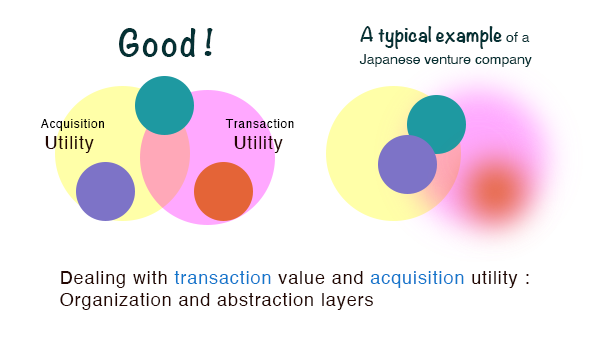
The reason Apple became the world's leading company is rooted in these very strategies and their division of labor: a foundation built on a 'Co-operative' model. However, depending on the environment, one often finds organizations that are ill-equipped to address these two types of utility—or in some cases, are not even aware of them.
Particularly in Japan, where roles like CPO and PdM are relatively new, many individuals in these positions have been hastily appointed. Their skills—which should inherently depend on deep insight and experience, such as abstract thinking and the ability to navigate between macro and micro perspectives—remain underdeveloped. Consequently, they often rely on trendy, rigid frameworks (both domestic and international) as a lifeline, implementing them without any customization. In many cases, this only causes challenges to balloon, leading to a vicious cycle of stagnation.
(Note: As illustrated in the diagram above, the left side represents an organization like Apple, where the product line and marketing departments effectively address challenges across abstract layers, leading to success. On the right is an organization where a lack of insight and a failure to foster a culture of deep product inquiry have left a critical portion of the success-driving framework as a 'black box.' In such environments, the prioritization of high-level challenges remains 'unmanageable,' and cross-departmental collaboration is remarkably unstable.)
A Fragmented Vision Erodes the Entire Organization
With such a severely impaired vision, one might still manage to walk aimlessly to the nearest station, but winning in a high-stakes environment where extreme precision is required is impossible. The recognition of one’s own insufficiency is the true starting point; without it, the various elements can never ascend to '1'—the crucial leap from 0 to 1 in business terms. Consequently, in the 1 to 10 phase and beyond, those incomplete fragments that never fully became '1' act as a heavy shackle on growth.
Furthermore, from a 'Behavioral Economics' perspective, individual personnel and the organization as a whole are governed by 'Bounded Rationality' (which I will detail later), inevitably leading to a quagmire of inefficiency. This is often accompanied by an exodus of top talent. Viewed from any angle, it becomes clear that clarifying the vision—through a consulting service such as the one I provide—is essential to survival.
(Note: My approach and the specific strategies for addressing Transaction Utility—including the resolution of the organizational issues mentioned above—are integrated into the proprietary framework of my consulting service. I will reserve those details for that forum. Below, I will introduce several foundational concepts of behavioral economics that can also be found in various books and online resources.)
The Deceptive Nature of "MSRP"
Now—moving into the realm of 'unreasonable' methods—are you familiar with the concept of 'Manufacturer’s Suggested Retail Price' (MSRP)? It is often displayed above the actual selling price, serving primarily as a point of comparison.
For everyday items like detergent or toilet paper, our brains can instantly retrieve a fair market price. However, when it comes to a high-end rug for a new home or a suit in a boutique, judgment becomes remarkably difficult. In such cases, even if a seller sets an exorbitant MSRP (a 'rip-off' price) without any basis, our Transaction Utility can be triggered, leading us to perceive the actual price as a 'bargain.
Note: Since the specific pricing mechanisms and legal definitions of MSRP are outside my area of expertise, I encourage those seeking precise details to consult other specialized resources.
Selling an item for $9.99 instead of $10 is another classic tactic used to create a sense of value. We might feel little hesitation in dropping spare change into a donation box at a convenience store counter after checkout, yet we are dominated by entirely different emotions the moment we decide whether to pick up a product. Humans are truly complicated creatures. Merchants have traditionally thrived by exploiting these very psychological biases.
The Reality of Product Growth
Just as Richard Thaler was struck by the value function of Prospect Theory, my own perception of money shifted significantly as I internalized the concept of "Bounded Rationality"—the understanding that humans are not always rational in every decision. I became more cautious of the aforementioned sales tactics, yet I also developed a sense that when traveling, for instance, it is almost "inhuman" to behave like an Econ regarding one's memories. Whether it’s a windfall or a modest sum painstakingly saved through affiliates, I’ve learned to restrain both extravagance and stinginess. However, the most profound change occurred in my professional mindset.
To be blunt with a real-world example: in many projects where I serve as a consultant or lead designer, I am often asked to "create something just like [a benchmark competitor]." In essence, the request is to prioritize form over substance—even if it means imitation—just to get something that sells. In these moments, I make it a point to steer the conversation toward constructive, fundamental truths. Clients who were once overly eager for "Speed!" and "Results!" eventually hit the inevitable "wall" after a quarter or two. It is then that they naturally come to me, asking, "What does it truly mean to have a 'sense of product'?
Coda: The Psychological Wallet and the Complexity of Product Growth
I have witnessed countless initiatives in the field—companies aggressively pouring resources into "going viral," or establishing Customer Success departments for almost unbelievable reasons. However, because nothing is as unstable or ephemeral as the human heart, superficial techniques rarely yield meaningful fruit. (Even with something as crude as the "rip-off" pricing mentioned earlier, one might use it as a benchmark once, but it cannot sustain a legacy.)
For instance, the reason a Mozart symphony continues to captivate the human soul over centuries is that it is essential from the first note to the very last. If one were to imitate just a bar or two, the facade would crumble the moment the music failed to sustain that depth. Product growth is no different. Only through a fundamental elevation of quality—and the discipline to maintain it—can we truly resonate with the "shifting hearts" of consumers and extend the lifecycle of a product.
I must emphasize: these specialized fields are profound. The domains that many practitioners hope to "get through quickly"—such as the product line strategies discussed here—are far more vast and deep than most imagine. Through a professional lens, various problems lie hidden across the expansive map of the field where you compete. The gap between a client’s perception and the actual structural issues is often immense.
Business success, after all, depends on people. The consumer is human; the creator is human. If you wish to discover "reasonable" and authentic strategies to elevate Transaction Utility in your product growth, I invite you to reach out.