TP
 About
About
AI-Era Value:Unrivaled Expertise
 PdM / CPO
Navigating the Core: The Evolution of a Product Designer
Business / UIUX
 Dieter Rams
10(→3+2) Principles for Good Design
 Theory
A Professional Perspective: the Golden Ratio
 UI Design
Four essntial steps of Micro Interactions
 Behavioral Economics
Utility:The Psychological Wallet and the Complexity of Product Growth
 UX Framework
The Pros and Cons of User Interviews
Art
 Marcel Duchamp
Marcel Duchamp And Modern Art
 Donald Judd
Minimalism and Abstraction
 Storm Thorgerson
Intentional Ambiguity
Product
 King Sun Lamp
An Elegant Table Lamp in Newyork
 Beogram 4000c
Futuristic design that remains timeless.
 PH 4/3 lamp
Object's presence and its harmony with the space.
DesignPhilosophy10(→3+2) Principles for Good Design
Critique - 2024 -
Less, But Better
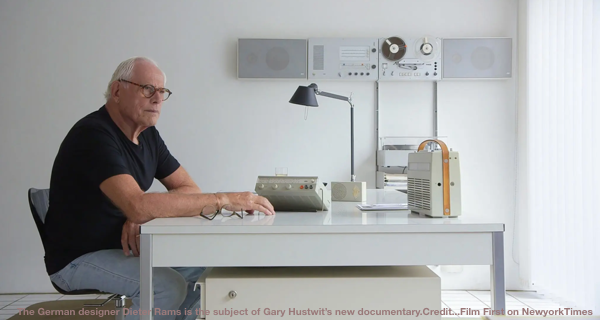
This phrase by Dieter Rams is legendary within the design industry. While it may sound somewhat abstract on its own, the statement is anchored by his Ten Principles for Good Design. Although ten distinct points may seem at odds with the concept of 'Less,' they prove that Rams’ work was born from profound thoughtfulness and deliberate consideration. Drawing from my own experiences in the field, let us reflect on what constitutes 'good design' and how a product comes to be cherished for a lifetime.
Dieter Rams
| Dates | 1932/5/20- |
| Notable Works | SK 4 Phonosuper (1956), RT 20 (1963), audio 310 (1971), ET 66 (1987), among others |
| Keywords | Industrial Design & Architecture |
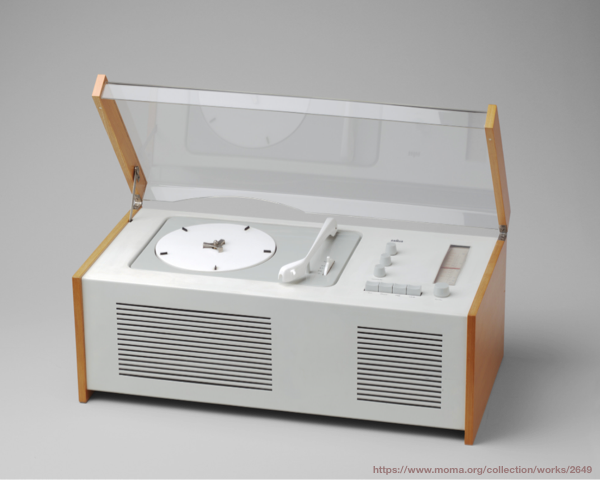
model SK 4/10 - 1956 -
Design does not necessarily have to be simple. Even a complex or 'cluttered' aesthetic can be strikingly cool if executed with a rich artistic sense. However, when a design is too aggressive or 'edgy,' it can make a room feel cold and disrupt the harmony of its surroundings. Often, our attachment to such products fades with age, yet Rams’ designs remain perpetually cool.
Pictured here is a radiogram famously dubbed 'Snow White’s Coffin.' As a timeless masterpiece that integrated both radio and record player, it continues to be celebrated today as an iconic product that transcends its era.
Of course, some of his works do possess a sharp, avant-garde edge, yet they invariably retain a certain softness or warmth. This is perhaps a hallmark of Rams, who studied architecture at art school. It reminds me of the paintings of Le Corbusier—a man who loved the arts—whose work, while far from technical perfection, radiated a distinct human warmth.
Note: After studying interior design and architecture at the Wiesbaden School of Art, Dieter Rams was hired by Braun in 1955 as an interior architect.
The Rams Framework: Ten Principles for Good Design
Listed below are Dieter Rams' Ten Principles for Good Design, as featured on the Braun website. Among these, the interpretation of the third principle—"Good design is aesthetic"—is perhaps the most challenging. Unless one can interpret "aesthetic" in a broader, more profound sense, one can never truly be called a first-rate designer.
- 1. Good design is innovative.
- 2. Good design makes a product useful.
- 3. Good design is aesthetic.
- 4. Good design makes a product understandable.
- 5. Good design is unobtrusive.
- 6. Good design is honest.
- 7. Good design is long-lasting.
- 8. Good design is thorough down to the last detail.
- 9. Good design is environmentally-friendly.
- 10. Good design is as little design as possible.
Innovation (1) and aesthetic beauty (3) can be pursued in tandem, yet they are inherently tech-dependent and require a profound consideration for technical constraints—reminding us that design is not merely about ideals.
Being long-lasting (7) is not solely a pursuit of physical durability; a product is cherished over time precisely because it is fundamentally aesthetic (3) and exceptionally useful (2). Because a design is honest (6), its details are executed with excellence and beauty (8, 3). Ultimately, it never leaves the user behind—it fosters understanding and remains unobtrusive (4, 5).
A design faithful to these principles is inherently restrained (10), and invariably, it returns to a state of beauty (3).
The Aesthetic Spirit: Philosophy and Vision
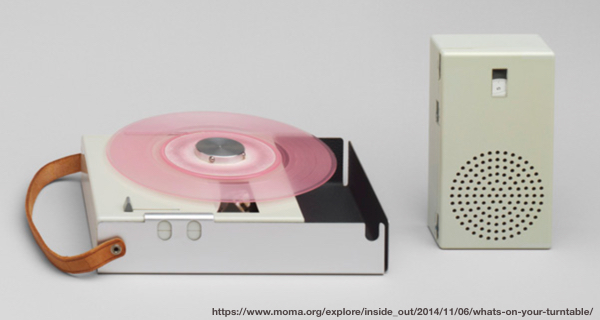
T4, P1 - 1959 -
Regarding innovation (1), one look at the P1 portable record player or the T4 portable radio—both released in 1959—is enough to command an appreciative nod. This level of innovation would surely leave even the original Sony Walkman in its shadow. Furthermore, the P1 carries a staggering episode concerning its utility (2); I encourage you to visit the product page to discover it.
As for being 'aesthetic' (3), this is ultimately a reflection of one’s own depth of study. Everything a designer has learned and understood manifests as expressive power, culminating in the final product. Since the user enters into a kind of 'covenant' with this depth, I place immense value on user engagement as a vital metric.
A deeper reading of principle (10) reveals that the iconic 'Less, but better' possesses an aspect that even questions the nature of abstraction. I feel that whether or not one possesses the literacy to interpret this can lead to either the long-term success or the failure of the product—and the business—one designs.
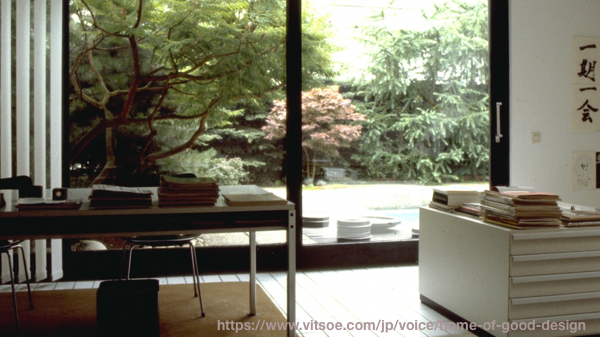
The Rams Residence and Garden - from 1971 -
Rams, whose grandfather was a carpenter, once observed: 'In traditional Japanese architecture, floors, walls, and ceilings are composed with such clarity and precision—materials and structures combined so deliberately—that it is far more sophisticated than the European aesthetic of opulence, patterns, and flamboyant forms.
Upon closer inspection of his residence, one finds a calligraphy scroll inscribed with 'Ichi-go Ichi-e' (One time, one meeting), and his garden itself is a modest space, much like a typical Japanese home. He describes his work in this wabi-sabi garden as 'very stimulating—a kind of design work comparable to furniture systems or appliances.
(Source:vitsoe.com)
The Blueprint for Success: My Five Principles for Great Products
To make the Ten Principles even "Better," I have applied the concept of "Less" and distilled them into five—effectively condensing the original ten into three core pillars and two foundational mindsets.
- 1. Innovative: Good design is innovative.
- 2. Functional & Enduring: Good design is useful, understandable, and sustainable.
- 3. Aesthetically Grounded: Good design is aesthetic.
- 4. Primal: Study deeply, and occasionally return to the roots.
- 5. Precepts: Long-term corporate success demands rigorous rules.
All essential product qualities are embedded in the second principle. To be truly functional means a product is accessible, intuitive, and long-lasting. It doesn't need to be "cool" immediately. In my own home, a certain Panasonic air purifier has just entered its 15th year; such products embody this principle perfectly. Elements 1 and 3 then act to elevate engagement. In these two categories, business success, the designer’s philosophy, and every ounce of creative intent find their fulfillment. As I have mentioned throughout this site, "Aesthetic" is a profound concept. Innovation, too, is what sparks that sense of excitement. A truly great product never grows stale.
An Homage to Masterful Architecture: Pursuing the Modest and the Good
What I wish to emphasize is the profound modesty of Dieter Rams. His fifth principle—"Good design is unobtrusive"—asserts that a product exists, first and foremost, as a tool. It is user-centric; it is neither mere decoration nor "art." Of course, the definition of "art" itself is complex, but I must clearly caution that this is a world away from the eccentric "contemporary art" imagined by those lacking a proper foundation in the arts.
As mentioned, Rams was influenced by Japanese architectural culture and captivated by structures of the Romantic era, such as the Eberbach Monastery and Castel del Monte. He critiques the weakness of many modern designers who show little interest in history. Personally, I interpret this "interest in history" as the very essence of "deep learning.

Castel del Monte - 1240s -
Working in design within Japan, I frequently encounter scenes where projects drift aimlessly, clinging to vague concepts and becoming obsessed with methodology alone. Ideally, whether through user engagement or any other metric, a product should be imbued with the insight and depth necessary to grant it even a glimmer of eternity. However, fueled by the 'DX boom' and the resulting influx of capital, we have seen a surge of low-caliber practitioners.
Whether in the realms of music, contemporary art, or design, many mistakenly equate a mere lack of elements with 'minimalism.' Even in the immediate field of interface design, there is a conspicuous increase in individuals who lack the sensibility to bridge the gap between meticulous detail and business strategy.
Crafting and Preserving Great Products: A Corporate Commitment
From my own practical experience, I have added a fourth pillar—"Primal": an understanding of the roots. Since the Middle Ages, countless masterpieces have been preserved and passed down. I believe we must turn our gaze toward this history, toward the source. Around the time Castel del Monte was erected, Japan saw the emergence of Unkei and Kaikei, arguably the greatest artists in Japanese history. Whether one links the Kongorikishi statues of Todai-ji to the calculators of Dieter Rams is a matter of perspective, but fundamentally, design should be proportional—a form shaped by vision. And vision is the synthesis of insight, experience, and the entirety of one’s cultivated skill and intent.

ET 66 - 1987 -
For the fifth pillar, I have introduced "Precepts"—a term more rigorous than "Principle." This applies both to corporate activity and the technical craftsmanship of design. Admittedly, it carries a certain weight; one might consider it a specialized safeguard for when a lead designer is no longer present, allowing for future updates.
Design is difficult. In startups and SMEs, I have seen environments vanish into nothingness once the lead departs. Maintaining philosophy and quality is no easy feat—it requires rigorous rules. Rams’ admiration for Castel del Monte stemmed from its "straightforward approach, patient perfection, and respect for good solutions." Whether it is the chords of a classical composition or the sketches of the Renaissance, anything that endures is inherently disciplined. There is always a rule; there is always a precept.